The field of semiotics studies how a shape, a sound, or a gesture comes to carry meaning. Sometimes that meaning is socially engineered to instil fear and maintain control over a group of people. I just want to meander with a handful of examples, of when someone decided to signify things, quietly or by force, so that maybe by the end you’ve got the vocabulary to recognize it when it happens.
To find a boogeyman

The Knights Templar were not just a military order, they also acted as Europe’s first multinational bank. Sometimes their seals reused engraved gemstones1 that had been passed around for centuries, including Gnostic amulets with the word Abraxas. People had been engraving Abraxas onto charms since at least 200 C.E.2. Basilides, a Gnostic teacher, used the name for a supreme being that was mostly unknowable. The seven Greek letters in Abraxas add up to 365 in gematria, matching the number of days in a year. That’s about as much as anyone can say for sure about what it meant to those who wore it. It’s hard to tell if any Templar saw Abraxas as more than just a handy engraved stone, or if I simply couldn’t find more information. But the historical record I found tells an even stranger story: the accusation that brought down the Templar Order in 1307 used a name no one had ever worn.
The name was Baphomet. Philip IV, king of France, ordered the arrest of the Templar Order, primarily to erase royal debts, and seize their vast wealth. When they were arrested, the guards used the seized strange engraved amulets and gemstones as a source of blasphemy. Under torture, the templars confessed to worshipping an idol called Baphomet3. Some described it as a bearded head, others as a cat, and some as a skull. Their stories did not match. The name itself had already been used in Europe for two hundred years. It was a garbled Old French rendering of “Mahomet”3, the period’s misspelling of Mohammed.
Whether the prosecutors chose the name on purpose or just repeated old Crusades-era slang, the result was the same. An idol that sounded close enough to the enemy’s prophet was easier to accuse of heresy than a figure engraved in gemstones with a Greek word on them. This was the perfect crime, demonise the warrior bankers by creating an enemy that no one would be able to refute.
Symbols, signs, and more in semiotics
A sign is anything that stands for something else: it could be a word, a picture, a gesture, or a shape. Ferdinand de Saussure4 explained that every sign has two parts. The first part is the signifier, which is the actual mark or sound you can see or hear. The second part is the signified, the idea or concept it evokes. There’s no inherent link between the two except through mutual agreement. Saussure pointed out that the connection is arbitrary: nothing about a shape or sound forces it to mean a particular thing. This is why meanings can be changed, taken away, or given to something new. The signifier stays the same while the signified can shift underneath it.
Charles Sanders Peirce5 approached it in a different way. He sorted signs by how closely they connect to what they stand for. An icon looks like its object. An index is tied to its object by a direct fact, like a footprint showing a foot or smoke showing fire. A symbol, though, has no natural link. It only means something because people agree on it, like the word “cat,” which does not look or sound like a cat. Symbols are the most fragile type. You can check an icon by seeing if it matches what it represents, or an index by looking at the fact behind it. But a symbol is just a shared idea, so it is easier to interpret in different ways, and sometimes the first person to speak gets to decide what it means.
Roland Barthes focused on two main ideas. Denotation is the basic, literal meaning of a sign. Connotation is everything extra that a sign picks up through use. For example, a skull means death, but it can also suggest piracy, poison, depending on the time period. Barthes used this difference to build his theory of advertising, calling the second layer of meaning a myth, an idea that appears to be a simple fact but is actually a choice made by someone.
Underneath all of it sits what Peirce called semiosis. Meaning is never assigned once and left alone. It keeps moving, each reading becoming the raw material for the next one, so a sign carries the sediment of every hand it’s passed through. A shape gets its meaning through shared agreement, and since that meaning is not permanent, someone with enough influence can change it. If we see a sign like ours, it feels like a badge. If we see the same sign as belonging to others, it can feel like a threat. Both meanings use the same symbol.
Fear is what narrows our view. When people are calm, a sign can have several meanings, and most do not worry about it. But when fear takes over, people quickly stop accepting different interpretations, and the sign starts to seem like it means either us or them, safe or dangerous, good or evil. Courts, tabloids, sermons, and news reports reinforce this single meaning by repeating it, even if the facts do not support it.
Symbolizing the old goat
Five and a half centuries later, a French occultist, Éliphas Lévi, published the two volumes of Dogme et Rituel de la Haute Magie6 in 1854 and 1856, and the second volume begins with an image he drew himself7: a winged, goat-headed, androgynous figure captioned Baphomet. Lévi was not reviving a devil. The goat’s head symbolised instinct and raw nature, the wings represented rising above the material, the torch between the horns signified illumination, and the caduceus at the groin denoted the reconciliation of opposites. Each part of the image is intended to be read literally, like a diagram. He took a name originally devised to condemn heretics and reinterpreted it to mean the opposite.
He’s also the first recorded writer to give a negative meaning to the inverted pentagram8. Upright it represents spirit governing the four elements, a sacred figure. When it’s flipped so two points face up, it’s “Satan as the goat of the Sabbath.”9
Where Lévi’s interpretation differ from what follows is that neither of his readings were meant to instil fear. He was trying to teach mysticism through diagrams, the way Kabbalists used Hebrew letters or apophatic theologians used metaphor: tools for approaching something words alone couldn’t hold.
Appropriating in the name of

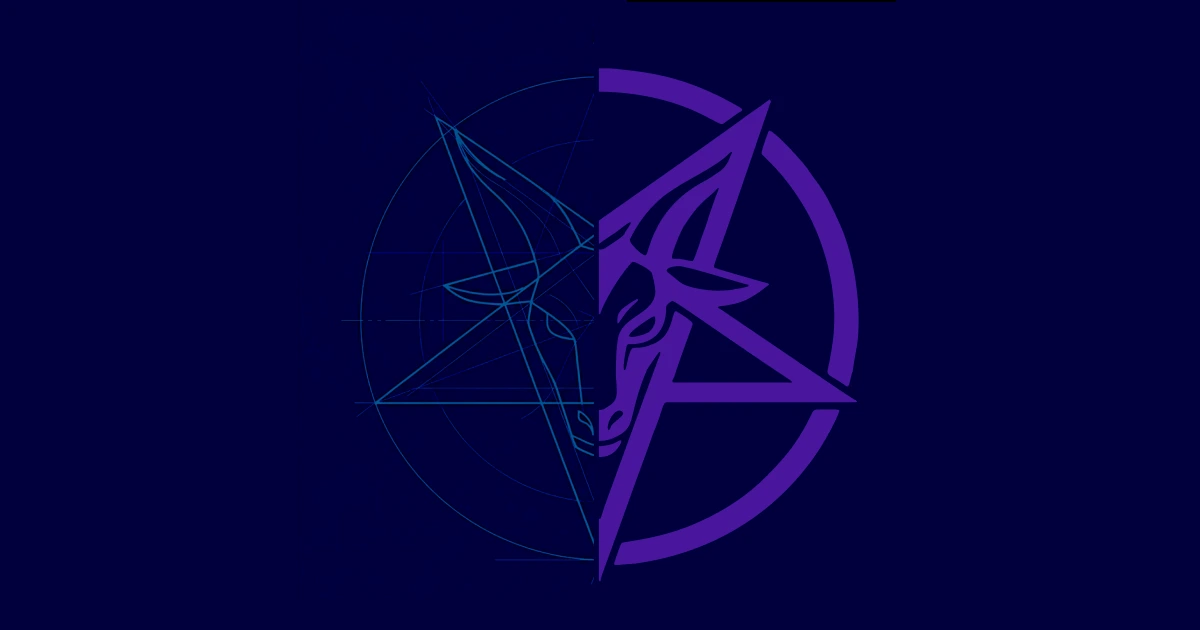
Later on, another French occultist, Stanislas de Guaita, put a goat’s head inside Lévi’s inverted pentagram10, ringed by five Hebrew letters spelling Leviathan, in his 1897 book La Clef de la Magie Noire11.
Anton LaVey found it while researching what he called “the black arts” in the 1960s. He redrew it with cleaner circles, a more geometric goat, Hebrew lettering restyled to look more serpentine, and had the design copyrighted12 to the church he founded in 1966 under the invented name Hugo Zorilla. The Church of Satan adopted it as its official insignia. LaVey’s design is the most recognizable in popular culture.
LaVeyan Satanism doesn’t worship Satan13 as a literal being, it’s atheistic and theatrical. They use the name and the imagery as a provocation aimed at Christian morality. They started a joke, and in the 1980s, it started the whole Christian world crying. This period, named the Satanic Panic, spread through parts of the US, the UK, and beyond. During this time, symbols like pentagrams, heavy metal album covers, and Dungeons & Dragons were mistakenly seen as signs of an organised network of child-abusing devil worshippers. Britain’s Department of Health asked anthropologist Jean La Fontaine to investigate the matter thoroughly, and her research throughout Britain found no evidence14 of any organised satanic cult behind these claims.
Researchers who later studied the panic describe how it spread in what one paper calls “explosive amplification.”15 It was like a worldwide media cycle turned isolated stories into a nationwide certainty. There wasn’t any forensic evidence to back up these claims.
Collateral damage
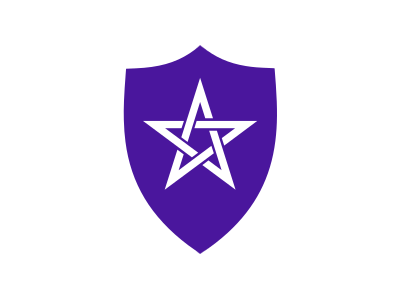
In Wicca, the pentagram16, often depicted upright within a circle as a pentacle, symbolises the five elements: earth, air, fire, water, and spirit. It’s a protective emblem that intriguingly blends influences from Christian traditions, just as the upright star seen in Christian history, painted on Sir Gawain’s shield as an endless knot17 representing five knightly virtues.
By the time the Satanic Panic was in full swing, most people had stopped telling apart an upright five-pointed star from an inverted one. Many still associate it with the devil, and the stigma lingered with a ripple effect18.
With Swastikas and flags
This entire pattern, at another scale, can be seen in the swastika. For millennia, it was a widespread blessing symbol representing good fortune across Hindu, Buddhist, and Jainist traditions19, appearing on artefacts from India to Britain to the Americas. Coca-Cola printed it on promotional items, and Boy Scouts wore it on badges. It was a symbol of luck.
Throughout the late 1800s, German nationalist writers associated the shape with theories of Aryan descent, and it was later officially adopted by the Nazi Party20 during the 1920 Salzburg Congress. In his book Mein Kampf, Hitler explained that the red colour stood for social ideas, while white represented nationalism, and the swastika itself symbolised the fight for Aryan victory, an explicitly antisemitic message. In 1933, Goebbels protected the symbol by banning commercial use without Party approval. Malcolm Quinn emphasizes its significance in Riefenstahl’s propaganda19, where it served as a symbol of both personal and national identity21, even representing Hitler when he was not present. Today, apart from its use in Asian religious contexts, the shape generally no longer carries connotations of luck.
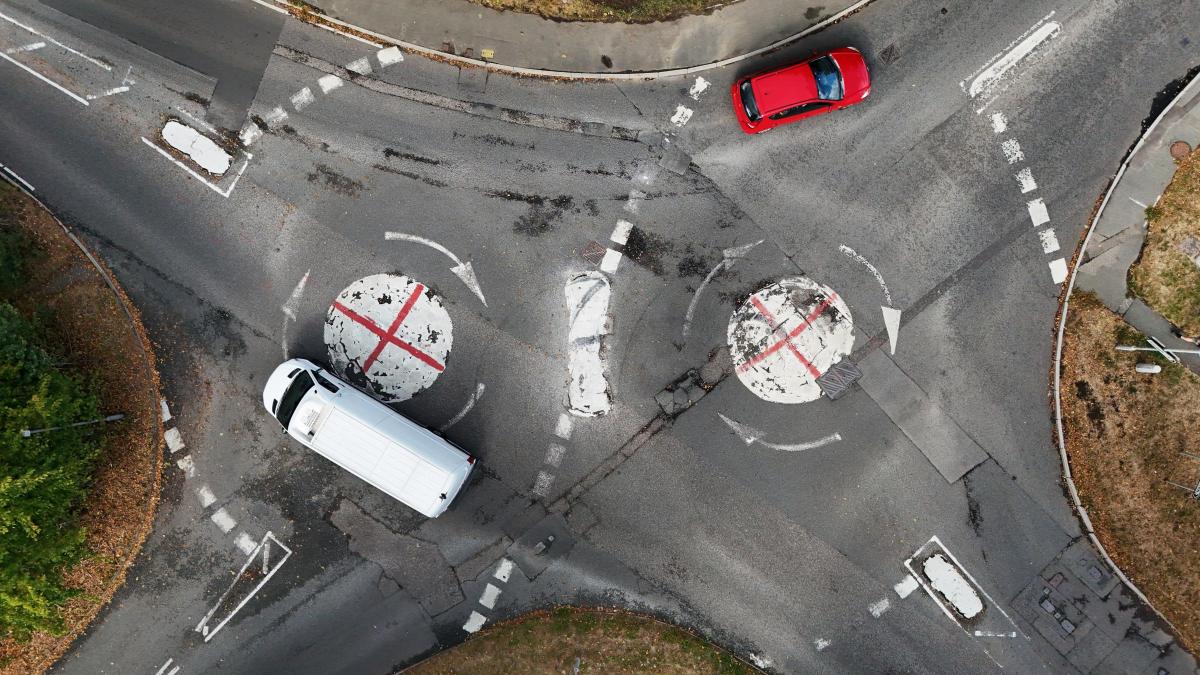
St George’s crosses painted over two mini roundabouts at the junction of Hitcham Lane and Gore Road, Taplow (Image: Jonathan Brady/PA Wire)
I do not want to focus only on the swastika as a major symbol, or ignore its importance in recent history. Similar patterns exist today, which have been repurposed to instil fear. One example is England’s national flag, The Cross of St George. It was mostly regarded as a football fan decoration, until groups like the National Front, the British National Party, and later the English Defence League began displaying it at rallies as a symbol of white English identity22, and started using it as a symbol explicitly targeted against immigrants. In recent years, an ordinary English person displaying the flag outside their home risked being misunderstood as making a statement23. One symbol that can mean very different things depending on who’s interpreting it, and often, the loudest voices shape how it’s understood.
We can sell fear to you wholesale
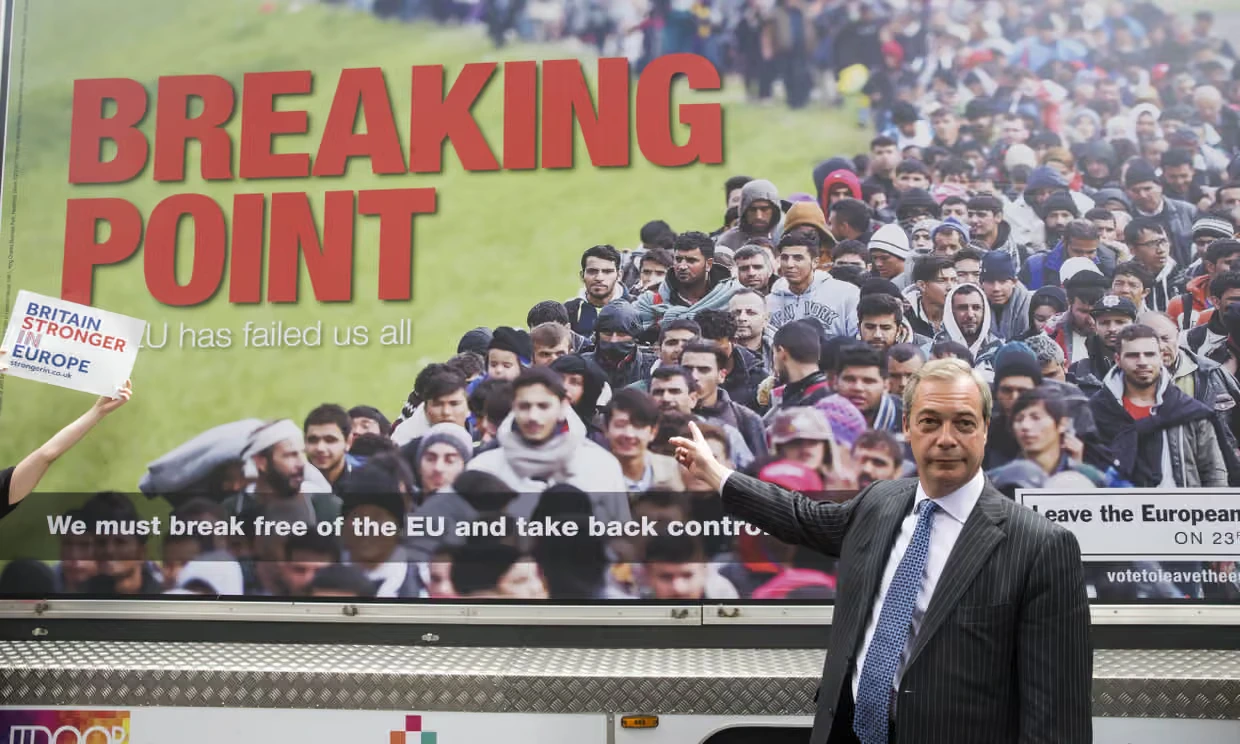
Nigel Farage anti-migrant poster. Photograph: Mark Thomas/Rex/Shutterstock
Back in 1964, during NBC’s Monday Night at the Movies, there was a memorable advert, promoted by the campaign of Lyndon Johnson, where a girl in a field counted the petals of a daisy24. Her quiet moment transitions into a man’s countdown, leading to a nuclear mushroom cloud filling the screen. The networks later replayed it on the evening news without any charge, making it a significant moment in broadcasting history. Goldwater (President Johnson’s competitor) isn’t directly named, and there’s no explicit claim, so there’s no way for anyone to verify or challenge it. This campaign insinuated that if you didn’t vote for Johnson, you would be supporting a potential nuclear anihilation.
In 2016, just a week before the EU referendum, UKIP revealed a poster featuring a photo of refugees25 at the Slovenian border from the previous year, with the caption BREAKING POINT. This caption borrowed a sense of urgency and credibility, however the photo was not taken in Britain’s borders, and there was no breaking point. The poster was reported to the Metropolitan Police for inciting racial hatred, but no charges resulted. Michael Gove admitted he shuddered26 at it, while George Osborne remarked it had echoes of the 1930s.
Neither piece really argues. Instead, both use a sign and allow the audience’s existing fears to interpret its meaning. An accusation without evidence can still be powerful, it just needs a platform to stand on.
Roland Barthes explored similar ideas in Mythologies27, a collection of essays from 1957, where he examined how advertisements do more than just sell products, they evoke emotions and lifestyles. For example, a perfume ad isn’t just about the liquid in the bottle; it suggests elegance or seduction, creating an entire way of life that people accept as truth, even though it’s a choice made by the advertiser. Barthes referred to this as “depoliticized speech.” Jean Baudrillard28 took this concept even further by explaining that in our media-rich world, signs often lose connection with reality and instead circulate as their own reason for being, what he called hyperreality. In this context, a logo influences us simply through repeated exposure, it doesn’t even need a real-world counterpart anymore.
Back in the early 1920s, the Lambert Pharmacal Company had a surgical antiseptic that had already been used as a floor scrub and a treatment for gonorrhea. They needed to find a new purpose for it29. They coined a word for the condition it would cure, welding the Latin halitus to the Greek suffix -osis: “halitosis.” There was no concrete evidence to investigate and nothing to disprove, only a name, along with the vague possibility that it might apply to you. It wasn’t real.
The serpent and the rainbow
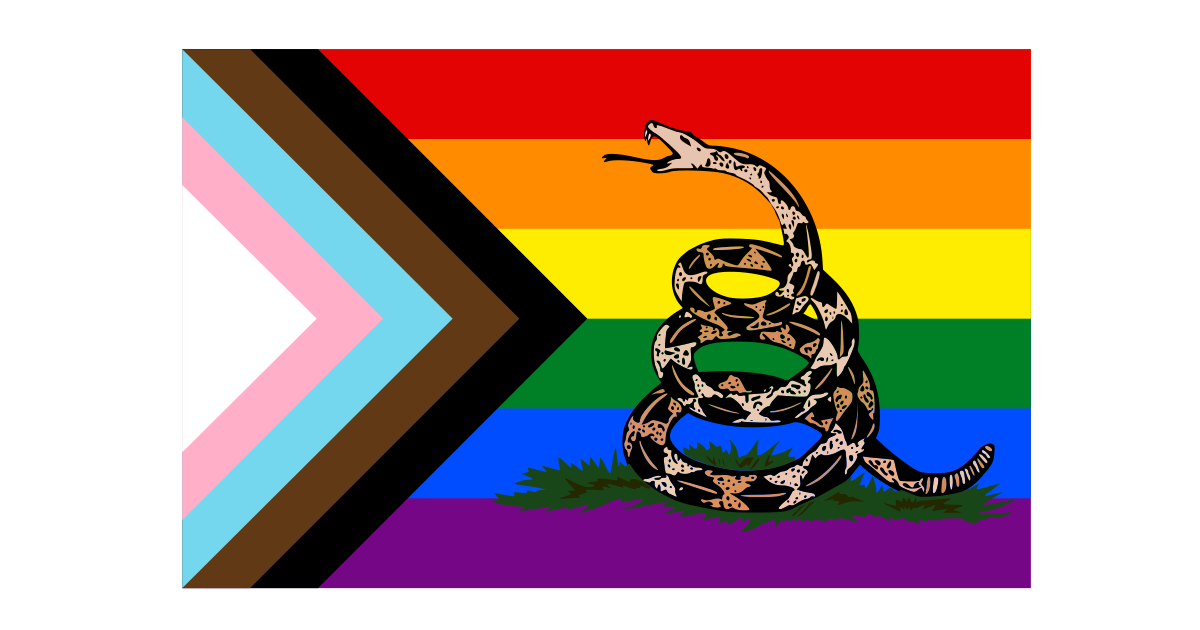
Gilbert Baker sewed the first rainbow flags30 with volunteers in San Francisco in 1978, assigning each stripe a meaning: pink for sex, red for life, orange for healing, yellow for sunlight, green for nature, turquoise for magic, blue for serenity, violet for spirit. They flew at the Gay Freedom Day Parade that June. Pink dye was costly, so the flag lost a stripe, resulting in the familiar six-stripe version.
In 2015, MoMA added the stripes31 to its design collection, and these stripes appeared on various corporate logos every Pride month for 10 years. However, by 2025, many companies started to pull back32. Mastercard, Citi, Pepsi, Nissan, and PwC left NYC Pride, which then finished the year with a loss of nearly three-quarters of a million dollars. According to Gravity Research, nearly 40% of corporate communications officers were pulling back, with most citing pressure from the new administration as a reason. After all, the stripes were worn when they didn’t cost anything and abandoned once they did, revealing their virtue signalling attitude.
In March 2025, Utah took a significant step by becoming the first state to ban the flag33 from classrooms and government buildings. They imposed a fine of $500 a day34 for each flag still flying. Idaho followed with a more limited version that specifically covered schools. The official reason given was to maintain political neutrality, but it seems to reflect the familiar idea that having one flag on the wall sends a message, while hanging multiple flags simply reflects the status quo. Nobody actually disagrees about what the stripes denote. The fight is over what the flag is evidence of.
Point the same machine the other way, and you get the Gadsden flag (now known as a symbol for right wing libertarianism). Christopher Gadsden created the coiled rattlesnake in 1775, inspired by Benjamin Franklin, who in 1754 cut a snake into eight pieces for Join, or Die35. The 8 pieces symbolized the 8 colonies, and it was. call to join forces against England.
Recently, the flag was used by the Tea Party (a right-wing American movement) in 2009, and on the January 6 riots, in 2021, when there an attempt to stop confirming the election of Joe Biden. When a black postal worker protested that a colleague wore it daily, claiming Gadsden was a slave trader, the EEOC reinstated the case in 201636, stating that the flag “originated in a non-racial context’ but ‘in some contexts, conveys racially-tinged messages,’ leaving interpretation to the situation. Both flags, from 1775 and 1978, with documented meanings, now mainly symbolise allegiance and have ended up in legal issues over semiotics.
Conclusion
Every situation here is like seeing the same shape wearing different clothes. A sign by itself doesn’t tell the whole story. The connection between a shape and its meaning is a essentially a social construct. This means it can shapeshift to meet different people’s agendas over time. Semiosis is a continuous process of change that’s been ongoing for ages. This constant evolution is at the heart of how symbols function, which also explains why symbols are so easily taken and used by people.
Hopefully now you can notice the patterns of grifting propaganda and fear with symbols. Abraxas sat on a wax seal for hundreds of years, quietly observing the world. The symbols never changed. Everything around them did.